


Protect Your Vision Early
Interventional Glaucoma
Welcome to the next generation of glaucoma care. With amazing technological advancements, we are in the midst of a procedural revolution in the glaucoma sector. We are moving away from a reactive model—where we wait for damage to happen—toward a proactive, Interventional Glaucoma approach.

Glaucoma is a disease in which high eye pressure causes gradual and permanent damage to vision. It is also postulated to be affected by an imbalance between the eye pressure and intracranial pressure. If left untreated, glaucoma can lead to blindness that is irreversible with any treatment. There are many kinds of glaucoma treatments, but ultimately the goal is the same: control intraocular pressure (IOP).
What is Glaucoma?
What is Interventional Glaucoma?
Historically, glaucoma treatment followed a rigid "stepladder." We started with one drop, then two, then three, and only when those failed or the patient was losing vision did we consider surgery.
Interventional Glaucoma (IG) flips this script. It is a management philosophy that prioritizes early, safer, and more effective procedures like SLT (selective laser trabeculoplasty) laser or MIGS (minimally invasive glaucoma surgery) to lower eye pressure as early as possible to prevent any permanent damage to the optic nerve and your vision. Another goal is to reduce the treatment burden falling unto the patient by offering a solution from your ophthalmologist.

The "Drop Dilemma": Why Traditional Drop Therapy is Suboptimal
While eye drops have been a great first-line therapy for decades, they come with significant "real-world" challenges that we can now avoid:
The Compliance Gap: Life happens. Studies show that nearly 50% of patients stop taking their drops as prescribed within the first year. Missing even a few doses can lead to "pressure spikes" that damage the optic nerve. Every day that you miss your eye drop, the risk of glaucoma progression and permanent vision loss increases.
Ocular Surface Disease (OSD): Many glaucoma drops contain preservatives (like BAK) that are toxic to the eye's surface. Chronic use often leads to redness, burning, dryness, and itching—making the treatment feel worse than the disease.
Physical Limitations: For patients with arthritis, tremors, or Parkinson’s Disease, getting a tiny drop into the eye can be challenging and sometimes impossible.
Our Interventional Glaucoma Playbook
Dr. Kim offers a wide range of sophisticated, minimally invasive options designed to work with your eye’s natural anatomy.
Selective Laser Trabeculoplasty (SLT)
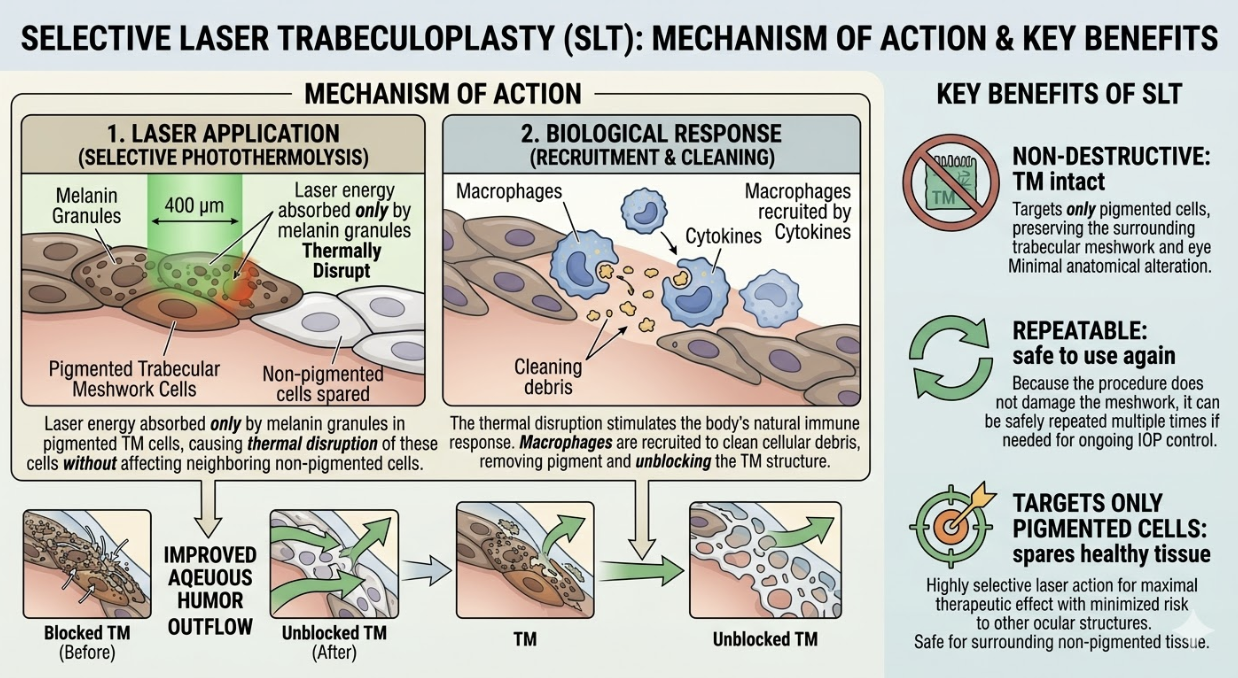
Our first-line recommendation, SLT is a gentle, in-office laser treatment that only takes a few minutes. It uses low-energy light to stimulate the eye's natural drainage cells to more efficiently drain the eye fluid and reduce intraocular pressure (IOP). It is non-invasive, repeatable, and can often replace the need for a daily drop. The LiGHT Trial demonstrated the superior efficacy and safety of SLT and has led many ophthalmologists to adopt SLT as a primary therapy for open-angle glaucoma. You can go home the same day with no vision change, as if nothing happened. Moreover, it is covered by most insurance plans. Although not guaranteed, many patients with mild glaucoma may get off their usual eye drops after successful SLT therapy. Blindly prescribing pressure-lowering drops is no longer the gold standard for glaucoma management.
Minimally Invasive Glaucoma Surgery (MIGS)
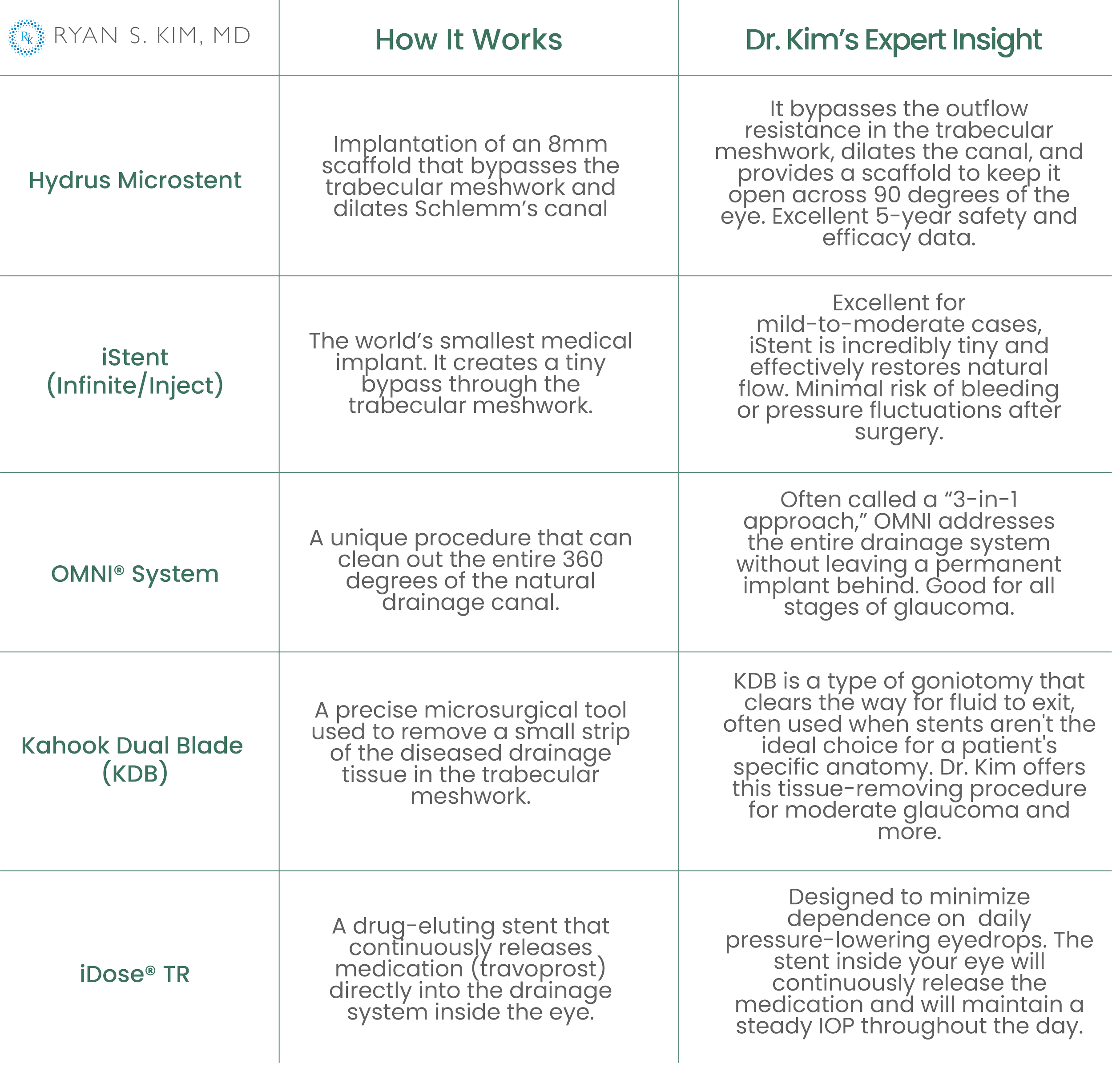
If you are undergoing cataract surgery, or even as a standalone procedure, we can enhance your eye’s drainage system using MIGS. These procedures have an excellent safety profile and rapid recovery times. It is a great segue between non-invasive treatments such as eye drops or SLT laser and more invasive traditional filtering surgeries, such as a glaucoma drainage device or trabeculectomy. Patients with all stages of glaucoma can be great candidates for MIGS. Dr. Kim will carefully assess your eye’s anatomy and glaucoma status before offering a tailored solution specifically for you.

Is Interventional Glaucoma
Right for You?
If you are tired of the daily hassle of drops, suffer from dry eyes, or have recently been diagnosed with glaucoma, it is time to discuss a procedural approach. Our goal is not just to "treat a number" (your eye pressure), but to preserve your quality of life and your vision for years to come. Dr. Kim actively advocates for evidence-based medicine, and Interventional Glaucoma has demonstrated excellent clinical efficacy and safety time after time.

Frequently Asked Questions
-
Open-angle glaucoma is where the natural drainage system of the eye is open but dysfunctional. The eye’s aqueous humor cannot be effectively drained via the “gutter” system, which leads to increased intraocular pressure. Narrow/closed-angle glaucoma is where the natural drainage system is shut down due to various reasons. In acute angle-closure glaucoma, the patient suddenly experiences severe pressure-like pain with vision loss.
-
Open-angle glaucoma is generally a silent disease where the patient does not notice any issues until an advanced stage. Acute angle-closure glaucoma will often lead to sudden, severe pressure-like pain in the eye along with acute vision changes.
-
Unlike traditional glaucoma surgeries (like trabeculectomy), MIGS procedures use microscopic equipment and tiny incisions. They are designed to be much safer, with a faster recovery time and fewer complications, while still effectively lowering eye pressure.
-
No. These devices are incredibly small. They are placed inside the drainage angle of the eye where they are invisible to the naked eye and cannot be felt by the patient.
-
This is the primary goal for many of our patients. While we cannot guarantee a "drop-free" life for everyone, a significant number of patients are able to reduce their medication burden, and many are able to enjoy freedom from drops for several years.
-
No! It is minimally painful, if at all. SLT is an in-office procedure that takes only a few minutes. We use numbing drops, so the most you might feel is a slight pressure. There is no downtime or vision change, and you can drive yourself home afterward.
-
If performed alongside cataract surgery, the recovery is identical to standard cataract recovery—usually a week of slightly blurry vision followed by rapid improvement. If performed as a standalone procedure, most patients return to normal activities within 24 to 48 hours.
-
Yes. Most major insurance providers and Medicare recognize SLT and MIGS (Hydrus, iStent, OMNI, KDB) as medically necessary treatments for glaucoma. Our office will coordinate with your provider to verify coverage.