



Corneal Diseases & Keratoconus
Dr. Kim can diagnose and manage various corneal diseases, including keratoconus, pterygium, Salzmann’s nodule, Fuch’s endothelial dystrophy, corneal foreign body and removal, allergic keratoconjunctivitis, among many more. In this section, we will focus on keratoconus.
What is Keratoconus?
Normally, your cornea—the clear, dome-shaped front part of your eye—is smooth and evenly curved. In patients with keratoconus, the collagen fibers that give the cornea its structure weaken. This causes the cornea to thin and bulge outward into an irregular and cone shape.
Because the cornea is responsible for focusing light into your eye, this shape change distorts your vision, causing blurring, glare, and sensitivity to light that cannot always be fully corrected with standard glasses. What are the usual solutions? Depending on the severity of your irregular astigmatism, we offer several advanced treatments.

Specialized Contact Lenses
Scleral Lenses
These are large-diameter rigid lenses that vault completely over the cornea and rest on the white part of the eye (the sclera). They create a smooth, perfect optical surface and trap a reservoir of soothing fluid against the eye, making them incredibly comfortable and highly effective for crisp vision. This negates the irregular shape of your keratoconic cornea and provides excellent vision back again.
Rigid Gas Permeable Lenses
Smaller rigid lenses that rest directly on the cornea to mask its irregularities. Similar to scleral contacts, but smaller and more comfortable.
Hybrid Lenses
These feature a rigid center for sharp optics surrounded by a soft outer skirt for improved comfort.
Intraocular Lens Implants and Cataract Surgery
For patients whose corneas have been stabilized for years, or for older keratoconus patients who are developing cataracts, we can address vision issues from inside the eye. Using advanced examination equipment, we carefully map the eye to determine if an intraocular lens (IOL) implant is a safe option.
In these complex cases, we often utilize premium Toric or small-aperture lenses to surgically correct the high amounts of astigmatism associated with keratoconus. Emerging technologies, like Light Adjustable Lenses (LAL), are also becoming an excellent option for keratoconus patients, allowing us to fine-tune and customize your vision after the lens is implanted.
Corneal Transplantation
When keratoconus is highly advanced—if the cornea has become dangerously thin or if severe central scarring blocks your vision—a corneal transplant may be the best path forward. Modern techniques have made this safer than ever. Whenever possible, corneal surgeons can perform a full-thickness corneal transplant (PKP), or a partial-thickness transplant (DALK), which replaces only the diseased outer layers of your cornea while preserving your own healthy inner endothelial layer, drastically reducing the risk of tissue rejection.
Corneal Crosslinking (CXL)
While we cannot reverse keratoconus, we can stop it from getting worse. Corneal Crosslinking (CXL) is a highly effective, minimally invasive outpatient procedure designed to halt the progression of keratoconus and stabilize your vision.
Think of crosslinking like adding a biological reinforcement to a weakened structure. By creating new bonds between the collagen fibers in your eye, we stiffen and strengthen the cornea, preserving its current shape.
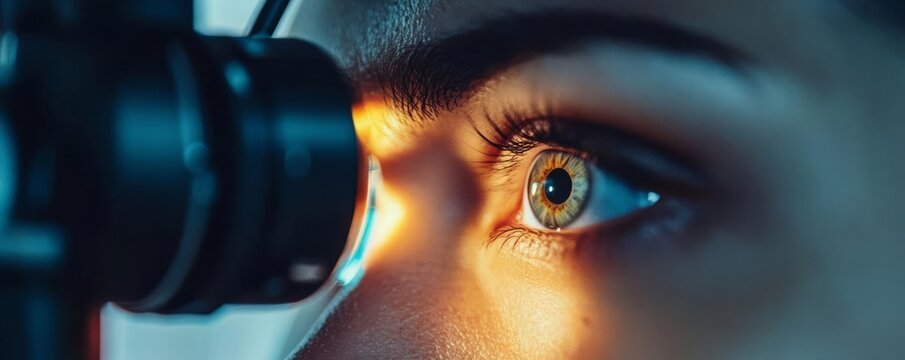
How Corneal Crosslinking Procedure Works
The CXL procedure is straightforward and typically takes about an hour in the office:
01
Preparation
We apply numbing drops to ensure you are comfortable. In the standard (Epi-Off) protocol, the outermost layer of the cornea (epithelium) is gently removed to allow medication to absorb deeply.
02
Vitamin Drops
We apply Riboflavin (Vitamin B2) eye drops continuously for about 30 minutes.
03
Light Therapy
We then shine a specialized, precise UV-A light onto the cornea for another 30 minutes while continuing the drops. The UV light reacts with the Riboflavin to create new structural bonds (crosslinks) within the cornea.

Frequently Asked Questions
-
No, CXL is not a cure, and it will not reverse the bulging that has already occurred. The primary goal of the procedure is to freeze the disease in its tracks, providing a stable corneal shape and preventing further vision loss. For many keratoconus patients with mild disease, early detection and treatment with crosslinking may preserve excellent vision without further intervention.
-
Yes. Because CXL stops progression rather than reversing it, your vision will likely be similar to what it was before the procedure. You will still need your glasses or specialized hard contact lenses (like scleral lenses) to achieve your best possible vision.
-
The procedure itself is painless because your eyes are completely numbed. However, it is normal to experience discomfort, a gritty sensation, and light sensitivity for the first 3 to 5 days of recovery while the surface of your eye heals. We will provide pain management protocols to keep you comfortable.
-
Most patients take about 3 to 5 days off from work or school. During this initial healing phase, your vision will be blurry. Your vision will gradually stabilize over the next few weeks to months.
-
Epi-Off Corneal Crosslinking is an FDA-approved treatment and is covered by most major medical insurance plans. Our office team will work directly with your insurance provider to verify your benefits before we schedule your procedure.