


Refractive Lens Exchange (RLE)
Your Vision, Reimagined
Are you in your 40s or 50s and increasingly frustrated by your dependence on glasses, especially for poor near vision?
Did you once have excellent vision and wonder why your prescription has been worsening lately?
You are likely experiencing presbyopia, which translates to aging eyes. As we have more birthdays, we will inevitably start experiencing an inability to zoom in closely to look at near objects like a phone screen. Dr. Kim can treat these vision issues with Refractive Lens Exchange (RLE) and restore excellent clarity, both far and near. RLE is a surgical procedure that replaces your natural lens that is becoming less elastic. Dr. Kim would then implant an advanced-technology artificial intraocular lens (IOL) that will not only provide crisp, bright vision but also eliminate the need for future cataract surgery.

Serving patients across Dallas, Irving, and Arlington, Dr. Kim is proud to deliver fantastic visual outcomes and maximal freedom from glasses or contacts after RLE. The goal is to revitalize exceptional clarity and focus across all ranges of vision. Expect nothing less than a bespoke experience where Dr. Kim will tailor the surgical plan specific to your eyes, lifestyle and visual goals.
What Does Refractive Lens Exchange Entail?
RLE is essentially an early cataract surgery. While traditional cataract surgery is performed once your natural lens becomes cloudy, RLE replaces your eye’s natural lens with an advanced Intraocular Lens (IOL) before a cataract even develops.
By upgrading the lens inside your eye, we can correct high levels of nearsightedness, astigmatism, farsightedness, and—most importantly—presbyopia (loss of ability to zoom in on near objects)
Why Choose RLE?
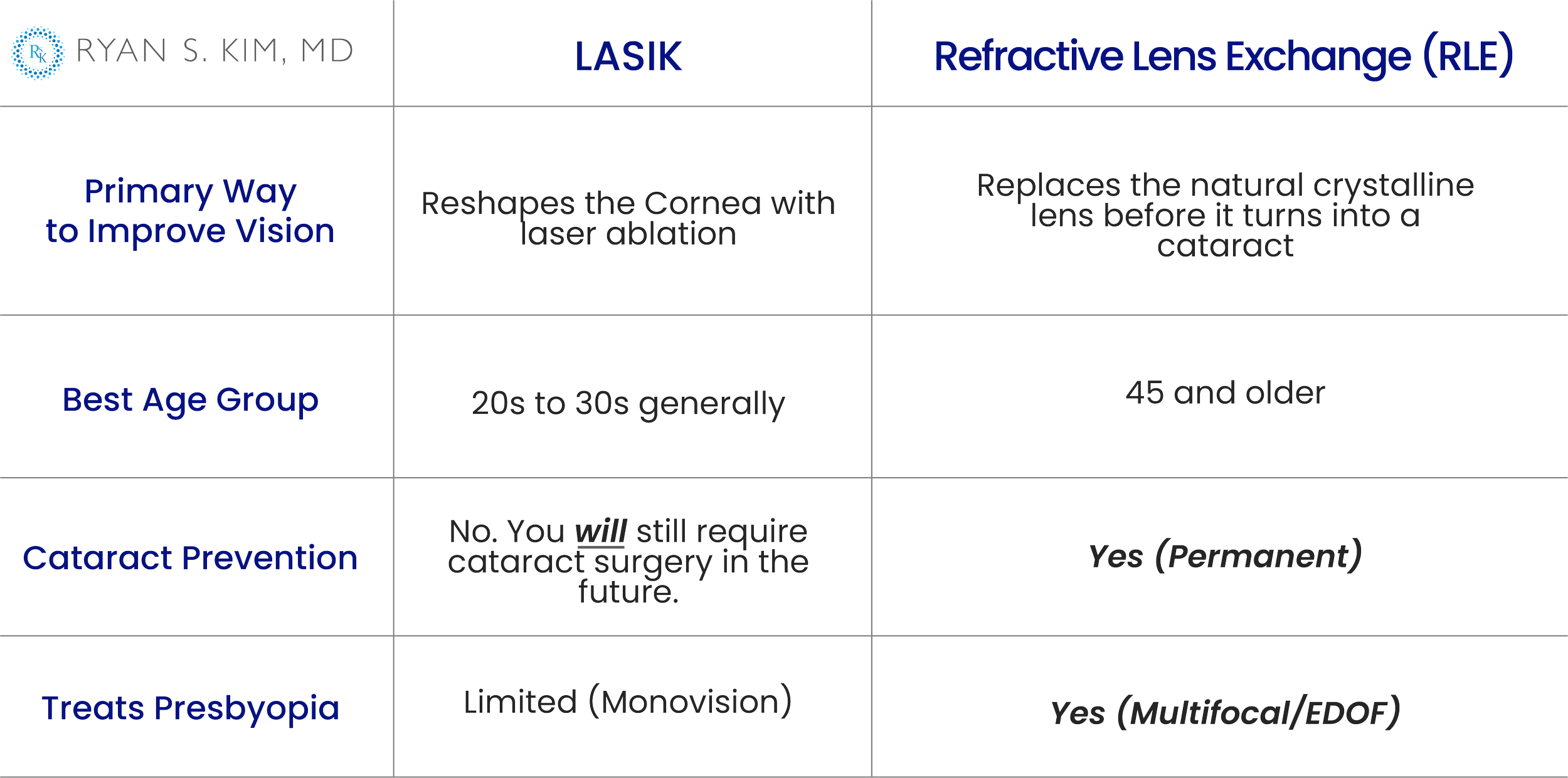
For many patients, RLE offers a more permanent and comprehensive solution than LASIK or other types of refractive surgery.
Permanent Correction
Because we are replacing the lens, your prescription will not "regress" over time. If you get LASIK in your 40s or 50s, you will still need cataract surgery eventually, and your prescription will continue to change gradually until cataract removal. Why do 2 surgeries than 1?
Eliminate Future Cataracts
Since your natural crystalline lens is removed, you do not develop cataracts later. While your friends and family may need cataract surgery down the road, RLE is a one-stop solution for your cataracts as well.
Presbyopia Correction
Unlike LASIK, which primarily reshapes the cornea, RLE addresses the internal lens, which is the actual source of age-related reading vision loss. LASIK buys you time until cataract removal, whereas RLE addresses the underlying reason for your presbyopia.
Advanced Lens Technology
We utilize the most advanced multifocal or extended depth of focus (EDOF), and toric lenses to provide a full range of vision—from your smartphone to the golf ball you hit 300 yards out.

The Procedure: What to Expect
RLE is a brief, outpatient procedure that typically takes about 10–15 minutes per eye.
Precision
From state-of-the-art diagnostic imaging to femtosecond laser, you enjoy the full suite of modern technological advancements to optimize the visual outcome after surgery.
Customization
Dr. Kim thoroughly reviews each case to ensure that you receive the most ideal lens implant after RLE that matches your lifestyle, visual habits, and occupation. It is extremely important that your surgeon takes the time to personalize your care.
Recovery
Most patients notice a significant improvement in vision within 24 hours and return to normal activities within a few days. You may experience mild discomfort, dryness, or sensitivity to light immediately after the procedure, but these typically resolve quickly with prescribed eye drops and routine post-operative care.

Comparison: RLE vs. LASIK
Frequently Asked Questions
Have more questions or need personalized guidance?
-
No, it is not covered by insurance, and you are responsible for the cost of surgery out of pocket. However, Dr. Kim offers a very competitive rate for surgery by teaming with the Eye Surgery Center of North Dallas.
-
Technically, yes. The surgical technique is identical. The only difference is the timing and the goal. Cataract surgery is performed to restore clarity to a cloudy lens; RLE is performed to achieve visual independence from glasses.
-
RLE is often the ideal choice for patients over 45 who are not good candidates for LASIK due to presbyopia or high prescriptions. They are generally tired of wearing reading glasses or bifocals. Individuals who are highly motivated to get rid of glasses after RLE are great candidates. RLE will eliminate the chance of developing cataracts later in life by removing the natural lens before it turns into a cataract. During your consultation, Dr. Kim will perform advanced diagnostics to ensure your ocular health is suited for this procedure.
-
Dr. Kim offers the latest and most advanced lens technologies on the market. These options include but are not limited to: Alcon PanOptix Pro and Vivity, Bausch&Lomb Envista Envy, J&J Odyssey, and more. Dr. Kim and his team will work with you to choose the right IOL based on your vision needs and expectations.
-
No. We use numbing drops and a light sedative to ensure you are comfortable and relaxed throughout the entire process. Most patients describe the sensation as a mild pressure, but no pain. The incision in which we insert the new artificial lens is so tiny that you cannot see or feel the incision.
-
Absolutely! With RLE, Dr. Kim will try to minimize any refractive error, including far or nearsightedness as well as astigmatism to achieve independence from glasses as much as possible.